Guides News (21 Posts)

1 2 3 . Last - Previous >>

Cyber Security Governance resources from the UK Government


Last month, the UK government addressed a letter to all CEOs and Chairs or leading UK companies emphasising that hostile cyber activity is increasing in frequency, sophistication, and impact. It also stated that cyber resilience is a critical enabler of economic growth and that organisations recover better when they have planned and rehearsed for worst-case disruption.

Although it references services and bills that are UK centric, there are some interesting points and information that could be considered and/or used in any country.

The letter asks companies to take three specific actions:

  • Make cyber risk a Board-level priority by using the Cyber Governance Code of Practice.
  • Sign up to the Early Warning service of the National Cyber Security Centre (NCSC) – a free service giving early alerts of potential attacks on your network. Your country may offer a national CERT service that is similar and if not but it could also be replaced with a
  • ...
    >>[READ MORE]

Jaguar down, insurance regrets?

On 31 August 2025, managers at Jaguar Land Rover's Halewood plant in the UK noticed systems behaving strangely. By the following morning, JLR's IT teams had confirmed an active intrusion. The company's response was drastic but deliberate: a near-total shutdown of its global IT network to stop the spread. Production lines in the UK, Slovakia, India, China, and Brazil went dark.

On 2 September 2025, JLR issued its first public statement: "JLR has been impacted by a cyber incident." That was the extent of what the company said publicly. The attacker said considerably more. A group calling itself Scattered Lapsus$ Hunters - a coalition linked to Scattered Spider, Lapsus$, and ShinyHunters - claimed responsibility on Telegram, sharing screenshots of JLR's internal SAP systems and stating that ransomware had been deployed across the company's compromised infrastructure.

As of 30 September 2025, production has still not fully resumed. JLR announced on 23 September that th...
>>[READ MORE]


How to secure your mobile phone and check for spyware?


To effectively detect if your mobile phone has been compromised or infected with spyware, as well as to secure it from potential future attacks, it is important to follow some security best practices.
Below, we will cover a thorough guide aimed at personal and work phones, which are often unprotected compared to corporate laptops with more advanced security tools (EDR/XDR) which are not often found on mobile phones.

  1. Detecting potential compromise on your Mobile device
    1. Review device configuration:
    2. Regularly inspect your phone's system settings and installed apps. Look for any configurations or applications that seem unfamiliar or that you did not intentionally set up.
      • Installed Apps: Unrecognized applications, especially those in foreign languages or from unknown developers, could indicate potential spyware. If you discover suspicious apps, consider a full device reset.
    ...
    >>[READ MORE]

A Generic Incident Playbook

Following the work started last year, we have now published a generic incident playbook that should be useful in any type of cyber incident and get your started on how to respond efficiently and rapidly
It is part of the wider set of incident playbooks (17 of them) and is available as a standalone 2x pages PDF on our github page:
ELYSIUMSECURITY Github Incident Playbook page

...
>>[READ MORE]

Free Cyber Incident Playbooks on GitHub

We are in the process of migrating our free resources/download to GitHub in an effort to facilitate the contribution from and to the cyber security community.

The first open source project we uploaded to GitHub is our cryptography project (BUGS) and the second one is our ES Cyber Incident playbooks project.

Our Cyber incident playbooks project is based on the work done by the CERT Societe Generale (SG CERT) which is available for free, under the Creative Commons Attribution 3.0 Unported License, on GitHub. Our project uses the same licensing model and you are free to use the content of our document(s) as per the aforementioned license and with referencing the author(s).

This project provides a number of Incident Response Methodologies (IRM), also called incident playbooks, aimed at helping a company with the handling of different t...
>>[READ MORE]


2019 CYBER SECURITY TRENDS REPORT OVERVIEW

In the past 6 months, ELYSIUMSECURITY has looked at 10 of the most popular Cyber Security reports of 2019 and created an overview document summarising their main trends and predictions.
The results will be presented at the next MU.SCL event (free registration HERE) but you can already have a look at the main findings by downloading the presentation in the DOWNLOAD section.

...
>>[READ MORE]

PHISHING PROTECTION FRAMEWORK

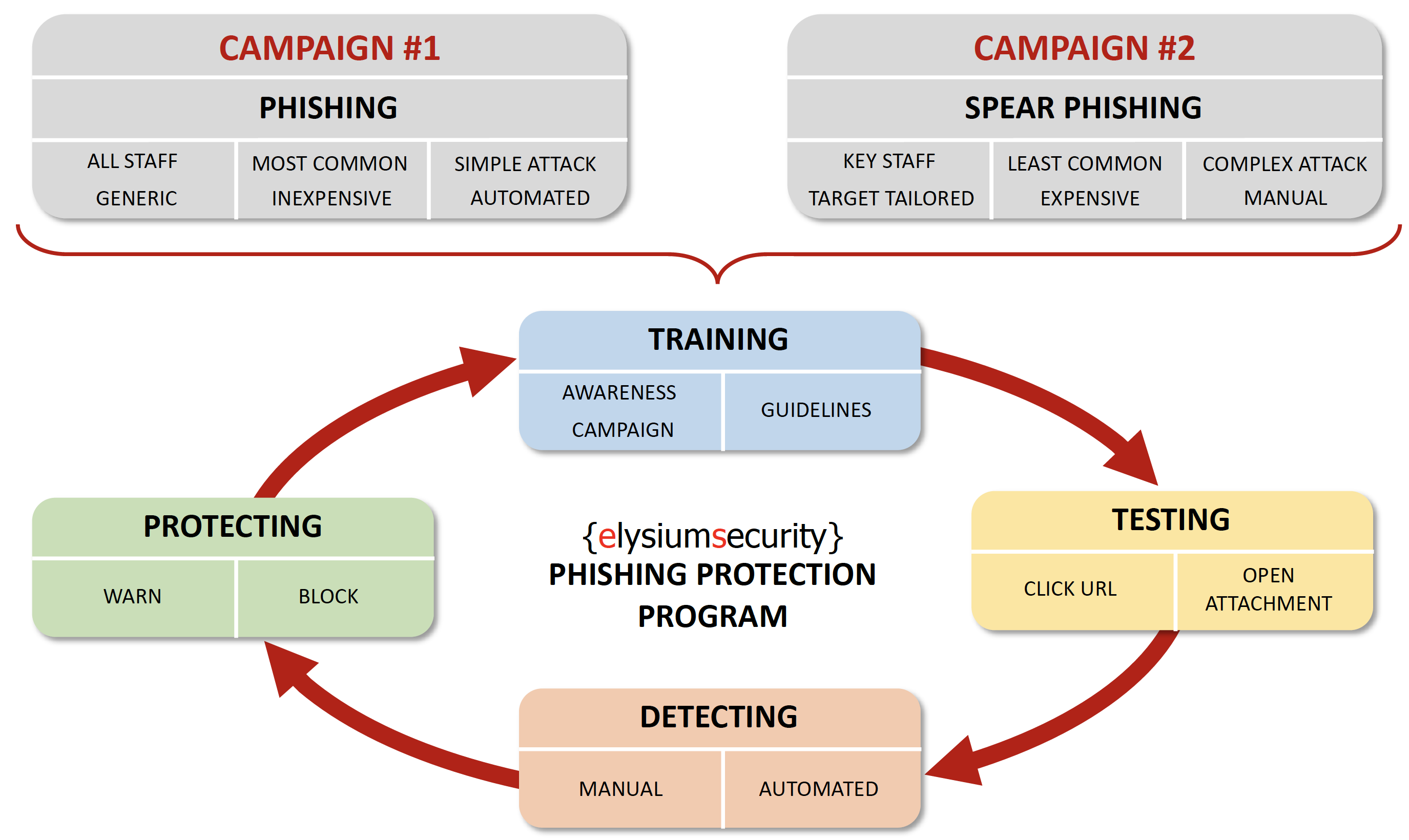
ELYSIUMSECURITY has designed a practical framework to help organisations implement an efficient Phishing Protection program.
Phishing has become the number one attack vector used by criminals to get around most companies defences and use social engineering to extract confidential information and conduct financial frauds.


For an efficient Phishing Protection program, organisations must consider not only implementing awareness and simulation campaigns but also integrate them to their phishing detection and protection strategy.


More information on how to implement this framework is available in our DOWNLOAD section.

...
>>[READ MORE]

HOW TO CHOOSE MICROSOFT 365 SECURITY PLANS AND ADD-ONS: E3, E5, EMS E3, EMS E5, 365 E3, 365 E5

Knowing what security features are included or not in the different packages offering from Microsoft can be confusing.
In this article, we will explain the overall principle of what all of those plans means.

For most companies, when it comes to Microsoft products you need protection for your EMAILS/DOCUMENTS/ENDPOINTS and for your ACCESS to Microsoft products (meaning AD, even if you are a Apple house)

The bottom line is that for ensuring you have the best security you want all or some of those security features:

  • Some advanced threat protection for your email/documents/endpoints:
    URL Link protection;
    Attachment protection;
    Identity and impersonation protection;
    Threat Intelligence;
    Alert for suspicious logins or activities;
    Logs and archiving;
    Advanced search and discovery;
    DLP
    Digital Right Management;
    Encryption;
    MDM (phones and laptops);
    GPO;
    Etc.

  • Some advanced threat p
  • ...
    >>[READ MORE]

    Cyber Security Planning - A simple 6 Steps Approach

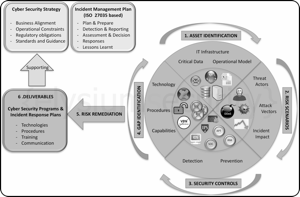
    Having a plan, or not, to secure your enterprise and respond to an incident could be the difference between closing down your company or seeing that incident through!
    Most large organisations invest considerable amount of time, money and resources to define a Cyber Security Strategy resulting in several Cyber Security Programs and Incident Management/Response Plans. All of which are in support of a wider Business Continuity Plan (BCP).
    This results in procedures, documentation, backup systems, regular incident simulations and dedicated teams.

    As long as these initiatives are kept up to date and still relevant to the organisation mode of operation then it should help a company survive most incidents.

    By contrast, smaller organisations and especially start-ups tend to focus first on getting the "job done" and then think of what to do in case of an emergency or incident.
    Their Cyber Security Programs and Incidence Response Plans are often limited to t...
    >>[READ MORE]


    How to build an efficient Anti-Phishing Framework?

    As our world reliance on electronic connection and communication is accelerating, cyber attacks are on the rise along with counter measure solutions in the form of endless new cyber security companies, consultants, expertise, software and hardware aimed at protecting individuals, assets, corporations and even nation states.

    However, even with all the tools and increasing cyber budget at our disposal, there is always one constant weak link: The Human element in the so called Cyber Kill Chain.
    It is this human element that can defeat the most sophisticated defence systems and it is why the use of Phishing and Spear Phishing attacks are so prominent and successful.

    Those attacks exploit human emotion, ignorance and credibility to bypass defences in tricking users to follow poisonous steps:
    Clicking on links, opening documents, accepting/ignoring security warnings and good practises, installing software, etc....
    >>[READ MORE]